

Your marketing is probably more fragmented than failing—and that’s actually good news. You can usually fix fragmentation in about 30 days with a focused plan and the right support.
You’re Everywhere, But Nowhere Feels Connected
If your social posts, emails, website, and print pieces all “sound” slightly different, your marketing is fragmented, not strategic.
Common signs:
- Different taglines or value props depending on the channel.
- Visuals and tone that don’t feel like they belong to the same brand.
- New campaigns that launch in a vacuum, without building on what you’ve already done.
30-day fix:
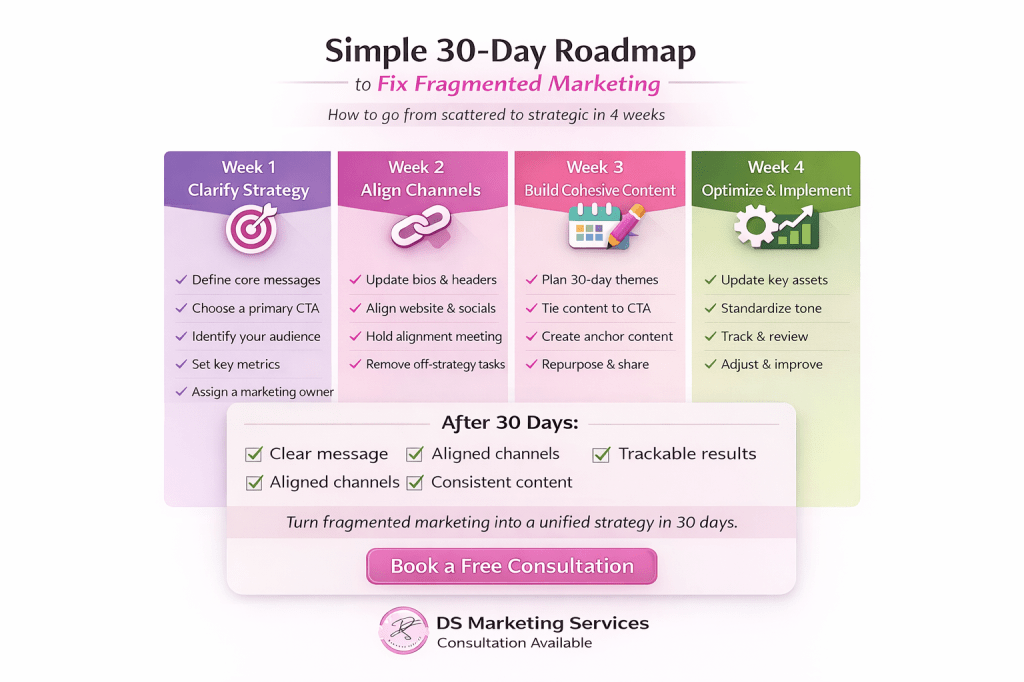
- Week 1: Define 3–5 core brand messages and one primary call-to-action you want most people to take.
- Week 2: Update your bios, headers, and About sections across key channels to match those messages.
- Weeks 3–4: Build a simple content plan where every piece ladders up to those core messages and the same primary CTA.
You’re Busy, But Not Moving the Needle
Fragmented marketing often looks “busy” on the outside—lots of posts, sporadic campaigns, random boosts—but doesn’t translate into clear, trackable results.
Red flags:
- You can’t easily answer, “What did this campaign actually do for us?”
- Different teams or vendors are chasing their own goals instead of shared outcomes.
- You make decisions based on “what we’ve always done” or gut feeling, not data.
30-day fix:
- Week 1: Choose 1–2 metrics that matter (for example: consult requests, booked appointments, or qualified leads) and write them down as your north star.
- Week 2: Audit current activities and pause anything that doesn’t support those metrics.
- Weeks 3–4: Re-align campaigns so every channel has a clear role in moving people toward your primary conversion.
Different People Own Different Pieces—But No One Owns the Strategy
Maybe you have one person posting on social, another sending emails, and a web vendor doing their own thing. When no one owns the whole picture, your marketing gets chopped into disjointed pieces.
You might notice:
- Campaigns launching without looping in all stakeholders.
- Conflicting priorities between departments or vendors.
- Repeating work because no one knows what’s already been done.
30-day fix:
- Week 1: Name one internal “marketing quarterback”—even if marketing is only part of their job.
- Week 2: Hold a 60-minute alignment meeting: list all current channels, who owns each, and what success looks like.
- Weeks 3–4: Create a simple one-page roadmap that outlines campaigns, timelines, and responsibilities so everyone runs the same playbook.
Your Customer Experience Feels Inconsistent
Fragmentation shows up in the customer journey: the vibe they get from your ads doesn’t match your website, your emails don’t match what your team says on the phone, and support messages feel like they’re from a different brand entirely.
Watch for:
- Tone shifts between marketing, sales, and support communications.
- Confusing or conflicting offers depending on where someone engages with you.
- Prospects asking questions you swear you’ve already answered “everywhere.”
30-day fix:
- Week 1: Map your key touchpoints from first impression to post-purchase (or post-visit) on a single page.
- Week 2: Choose one “signature” tone and 2–3 phrases you want to repeat across all touchpoints.
- Weeks 3–4: Refresh your top traffic pages, welcome emails, and scripts to match that tone and language.
Content Feels Random Instead of Strategic
When marketing is fragmented, content ideas usually come from “What do we feel like posting today?” instead of an integrated plan.
Signs this is happening:
- Long gaps between posts, followed by bursts of activity.
- Content that doesn’t clearly tie back to what your ideal customer is thinking or needing.
- You’re repurposing very little and creating from scratch each time.
30-day fix:
- Week 1: Clarify who you’re talking to and what problem you solve for them—write this at the top of your content plan.
- Week 2: Plan 30 days of themes based on customer questions, objections, and decision points.
- Weeks 3–4: Create “anchor” pieces (like one strong blog, landing page, or email) and repurpose them into social posts, short videos, and graphics that all point back to the same CTA.
Simple 30-Day Roadmap
Want Help Unifying It All?
If you’re reading this and thinking, “That’s us—we’re doing a lot, but it doesn’t feel connected,” you don’t have to untangle it alone. DS Marketing Services is built to take scattered, stressful marketing and turn it into a calm, cohesive strategy that actually supports your goals.
Book a free consultation, and we’ll walk through your current channels together—what’s working, what’s overlapping, and what you can streamline in the next 30 days to create marketing that finally feels intentional again.
 DS Marketing Services
Leave a comment